
Guide
How to find out who owns a piece of land in England
 Takeshi · 20 October 2026 · 6 min read
Before you can approach the owner of a site, you need their name and an address to write to. For most registered land in England, HM Land Registry holds both, and the title register that shows them costs £7.
This guide covers the checks in order: finding the title, reading the register, tracing a company owner, and what to do when the land is not registered.
1. Check the land is registered, and which title it sits in
HM Land Registry publishes the extent of every registered freehold as the INSPIRE Index Polygons, available free from its Use land and property data service. On a map, these show whether a title covers the land and roughly where its boundary runs.
Check the edges of the site as well as the middle. A plot that looks like one site is often split across several titles, for example a strip along the road or part of a neighbouring garden. Record every title that touches the land you are interested in.
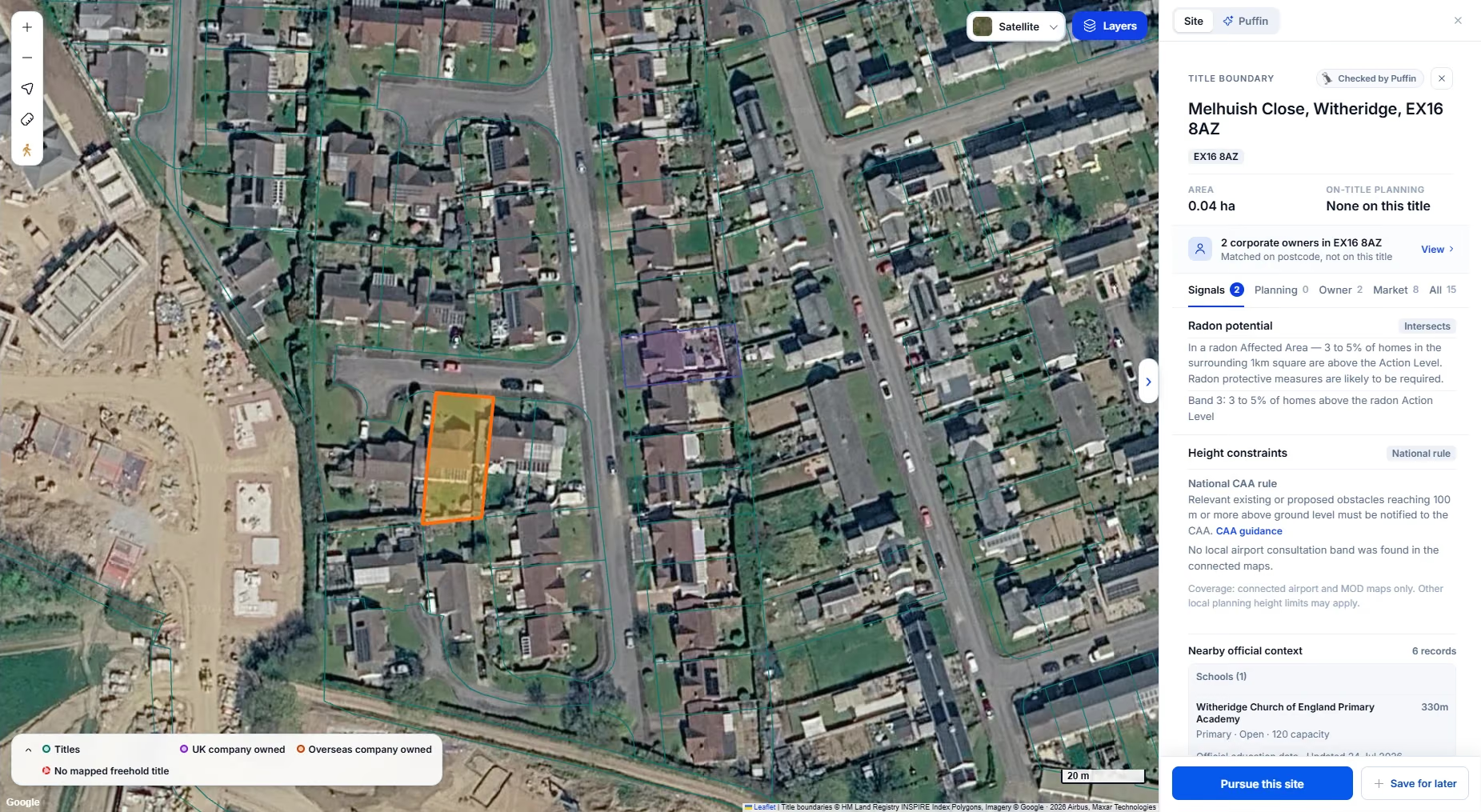
The example below is a small title at Melhuish Close in Witheridge. It covers 0.04 ha and has no planning applications. Two companies own land in the same postcode, but neither is matched to this title, which suggests the owner is a private individual.
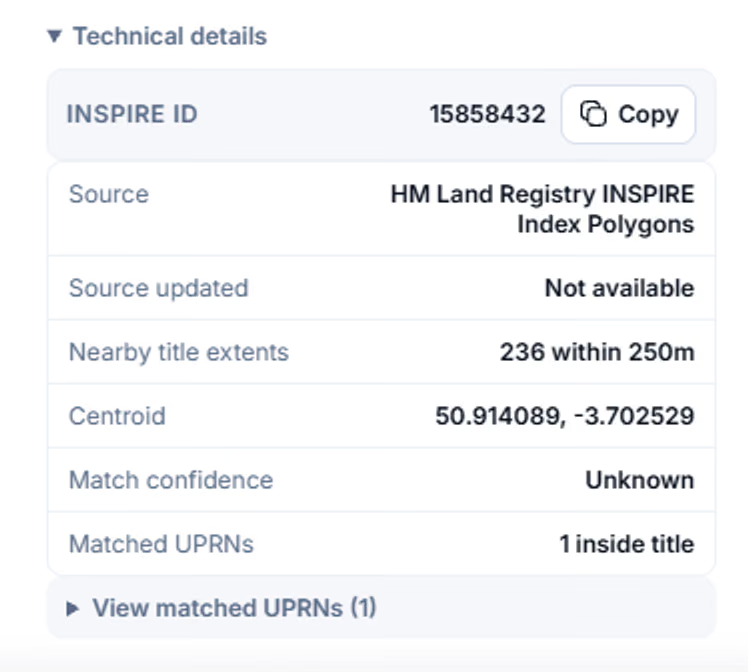
Each polygon has an INSPIRE ID. This identifies the polygon, not the title, so it cannot be used to order a title register. It is still worth recording, as it lets you find the same boundary again.
The other details give some context. There are 236 titles within 250m, so ownership in the area is closely divided, and one UPRN sits inside the title, meaning it contains a single address.
The polygons do not show who owns the land. They confirm that a registered title exists.
2. Look up the title, then buy the register
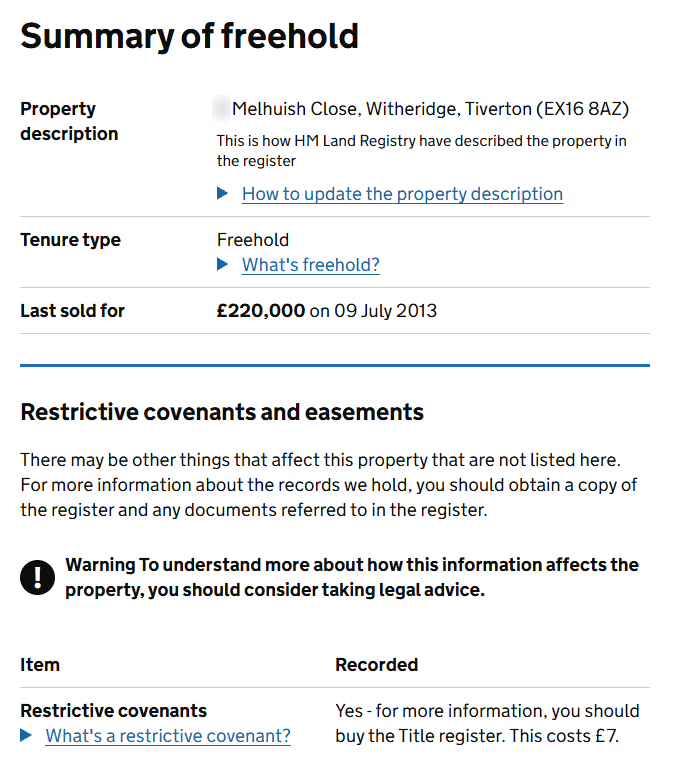
Search the address on HM Land Registry's Search for land and property information service. Before you pay, it shows a summary of the property description, whether the title is freehold or leasehold, the last price paid, and whether restrictive covenants are recorded.
For the Melhuish Close title, the summary shows a freehold last sold for £220,000 in July 2013, with restrictive covenants recorded.
The summary does not name the owner or give the wording of the covenants. Both are in the title register.
The title register names the registered owner, gives their address for service, and lists any charges, restrictions and covenants. Since December 2024, a digital copy costs £7 and the title plan costs a further £7 (fee changes on GOV.UK).
The proprietorship register gives the owner's name and their address for service. This is not always where they live now. It may be a solicitor's office or a previous home. The charges register shows mortgages, restrictions and agreements such as options. Any of these can mean a third party is involved in a sale, so check them before you write.
Also note the date the current owner acquired the land, as this can affect how open they are to an approach.
3. If the owner is a company, find the people behind it
HM Land Registry publishes free datasets of land owned by UK companies and land owned by overseas companies. Each record gives the title number, the company name and its address. Searching by company name can also show other titles the same company holds nearby, which is useful when assembling a larger site.
On the Landicia map, titles owned by UK companies are outlined in purple. The example below is a narrow plot behind Wheatsheaf Lane in Staines-upon-Thames. Selecting it shows the owner as Pill Box Chemists Limited, title SY829480, with a proprietor address in Colnbrook and an ownership date of August 2015.
Before: a purple outline means a UK company holds a title
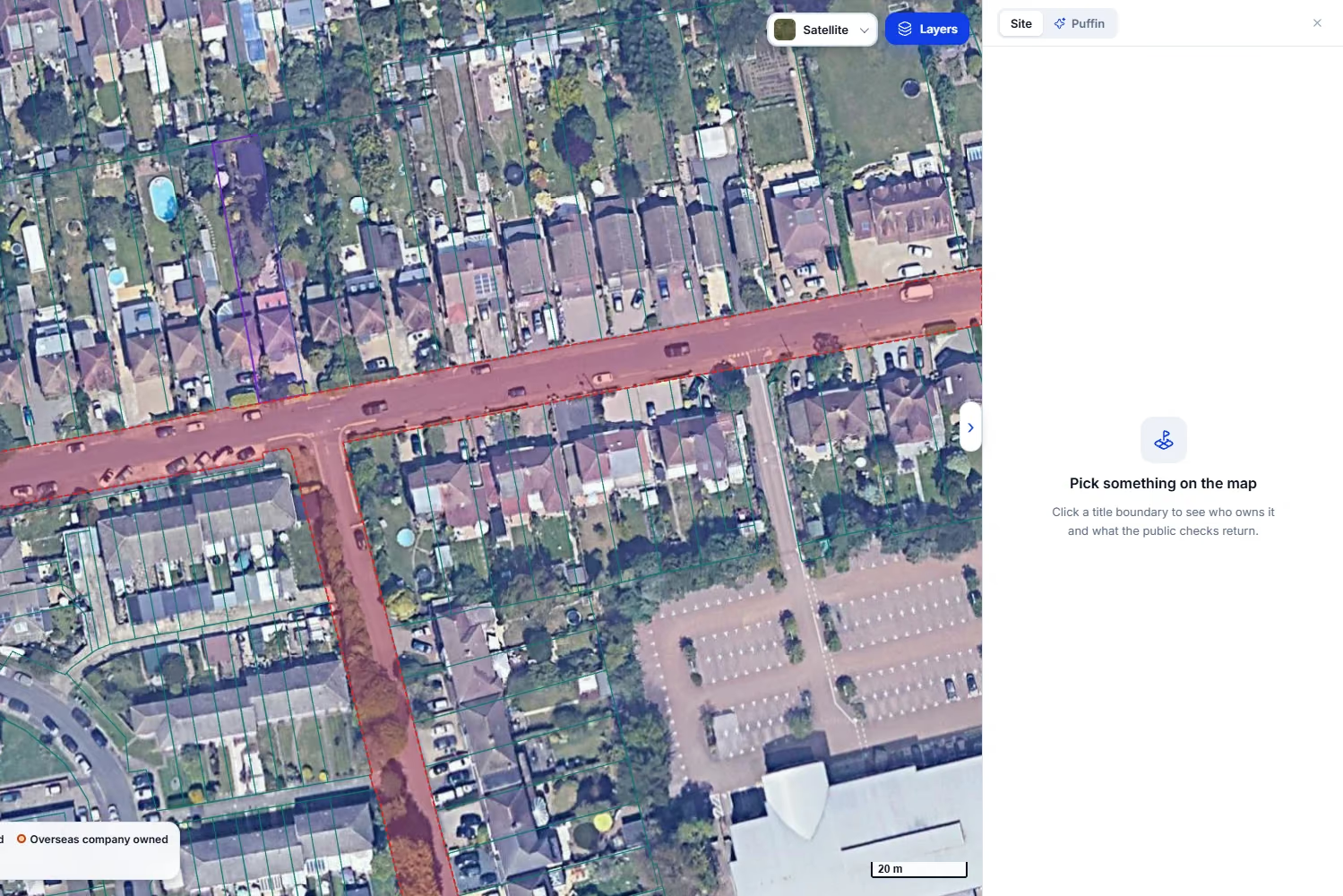
After selecting it: the owner in the side panel
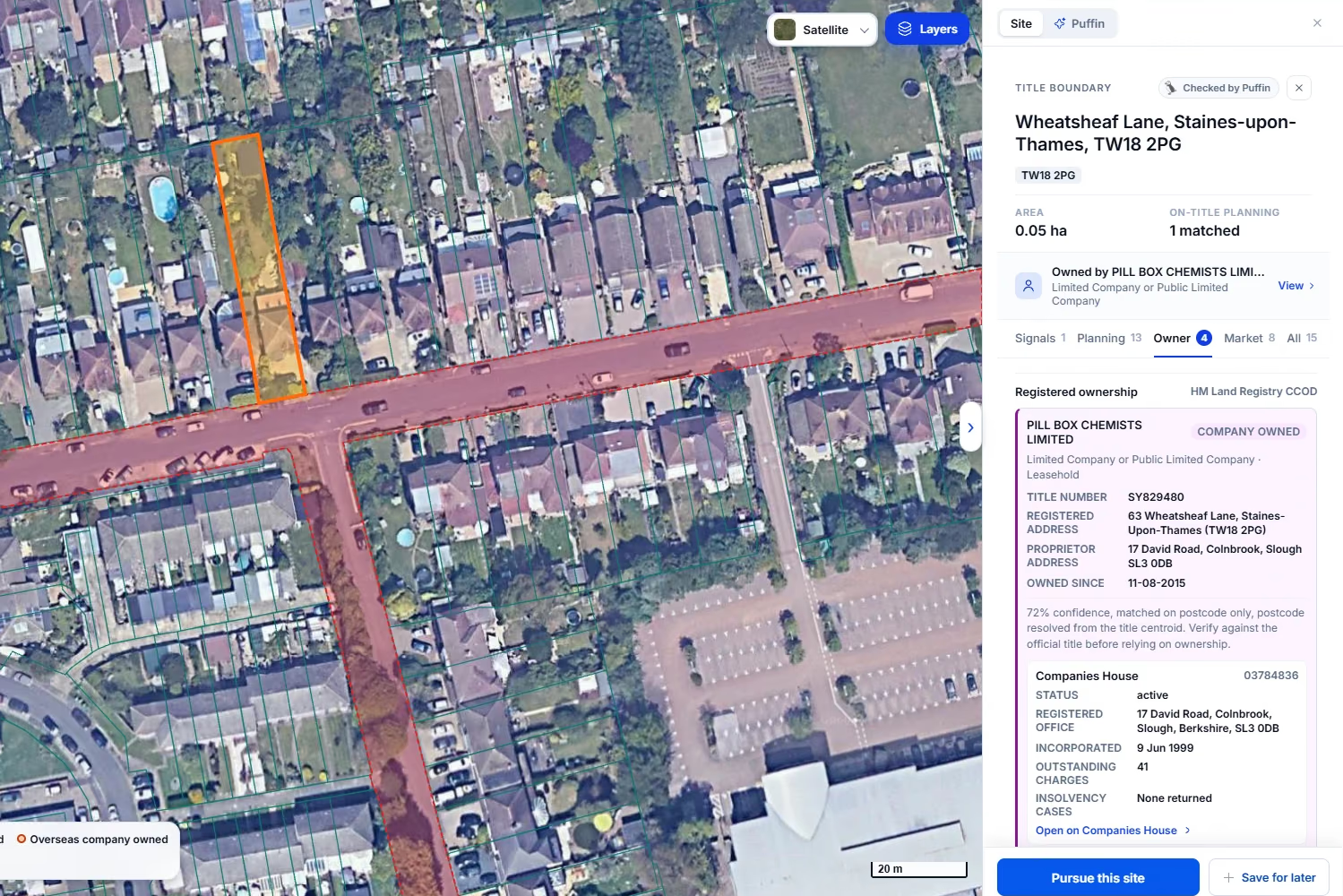
Two details in this record need checking. The title is leasehold, so the company may hold a lease rather than the freehold, and the freeholder may be someone else. The record is also matched on postcode only, with 72% confidence. The title register will confirm who owns the land.
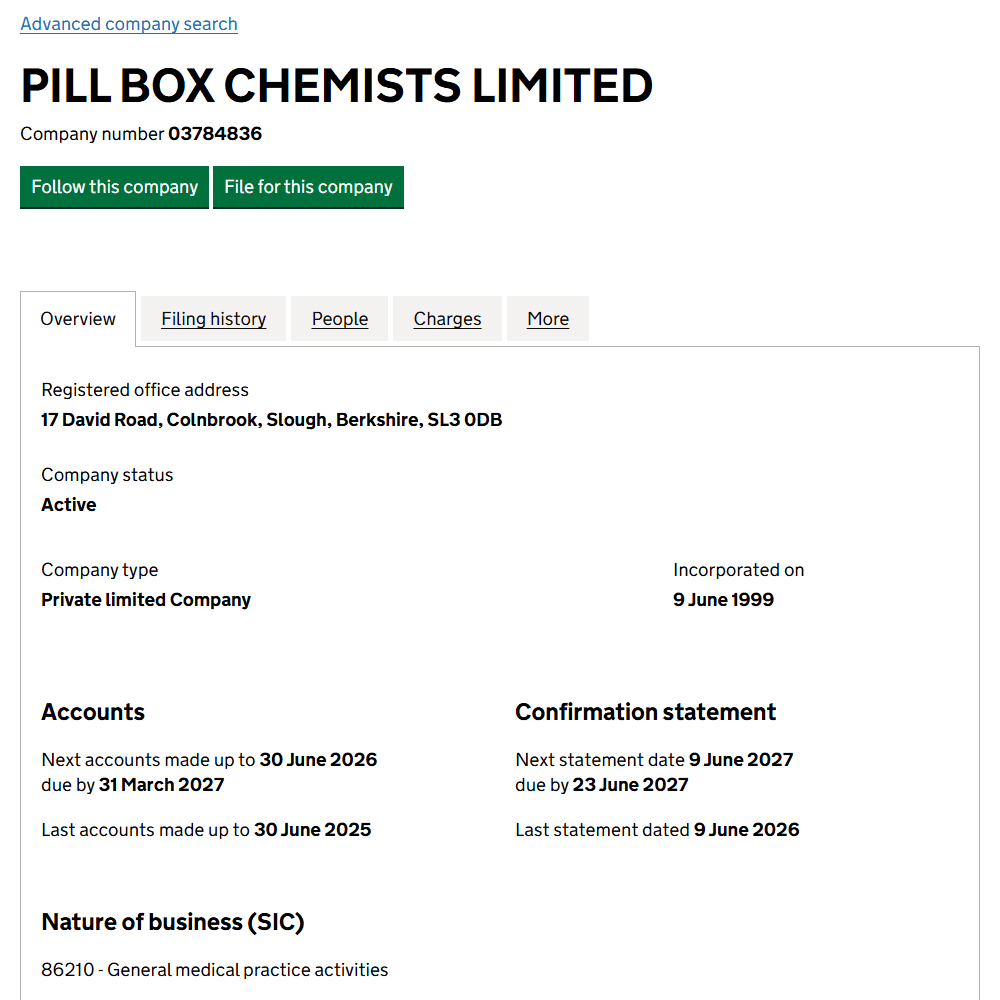
Next, look the company up on Companies House, which is free. Pill Box Chemists Limited is active, was incorporated in 1999, and is registered under general medical practice activities. Its registered office matches the Colnbrook address held by HM Land Registry.
The People tab lists the directors and persons with significant control. These are the people who can make decisions about the land. If a company has been dissolved, it cannot sell, so check its status before writing.
The company's line of business also gives useful background, as it indicates whether the land is likely to be held for trading, investment or development.
If the owner is an overseas entity, it should also be listed on the Register of Overseas Entities at Companies House, which records its beneficial owners.
4. If the land is not registered
Some land in England has never been registered, usually because it has not been sold or mortgaged for a long time. If there is no title polygon and a search finds no title, HM Land Registry does not hold ownership details for the land.
In that case, local enquiries are the main option. Neighbouring owners may know who owns or maintains the land. Planning applications on or near the site sometimes name an applicant or agent, and planning records are public. Signs and notices on site can also help.
An official search of the index map (form SIM) confirms whether land is registered. It is worth doing before spending time on other enquiries. HM Land Registry's practice guide 10 explains how to apply.
5. Keep a record for each site
Record your findings for each site so the research can be picked up later:
- Titles: every title number that touches the site, and the date you obtained each register.
- Owner: the name exactly as shown on the register, and the address for service.
- Company check: status, directors and persons with significant control, with the date checked.
- Other interests: mortgages, options, restrictions or covenants that could affect a sale.
- Gaps: any part of the site without a title, and the enquiries made.
- Contact: the address you wrote to, the date, and any reply.
Ownership and company details change over time. If a register is several months old, check it is still current before you write again.
Where Landicia fits
In Landicia, you can select a title on the map to see its registered owner, any company behind it, and the planning history on and around the site. Title documents cost the standard £7 HM Land Registry fee. Letters to owners are drafted from the site record, and replies are logged against the same site.
If you would like us to search against your brief, Landicia Assisted is our sourcing service. For finding sites in the first place, see our guides to SHLAA and HELAA sites and title boundaries.
Fees and official sources checked on 20 October 2026. Check HM Land Registry's current fees before ordering documents.
See it on your own area
We load your target area before the call.