
How to write a letter to a landowner (with a free template)
 Takeshi · 2 November 2026 · 6 min read
Once you know who owns a site, the next step is usually a letter. If the land isn't being marketed, writing to the owner directly is often the only way to start a conversation about it.
Here's how to approach a landowner by post, with two letters you can adapt: one for the first approach and one for the follow-up.
1. Check the site before you write
You need the owner's name and their address for service, both from the title register. If the owner is a company, check on Companies House that it is still active and note who the directors are. Our guide to finding out who owns land goes through this step by step.
Note the title number and the site address too, so you can say exactly which land you mean.
Then look at the planning history on the site and next to it. A previous refusal, for example, is worth knowing about before you make contact.
Read the rest of the register too. The charges register shows mortgages, restrictive covenants and notices of other interests, such as an option to purchase. The proprietorship register shows any restrictions. Any of these can affect whether, or how, the land can be sold.
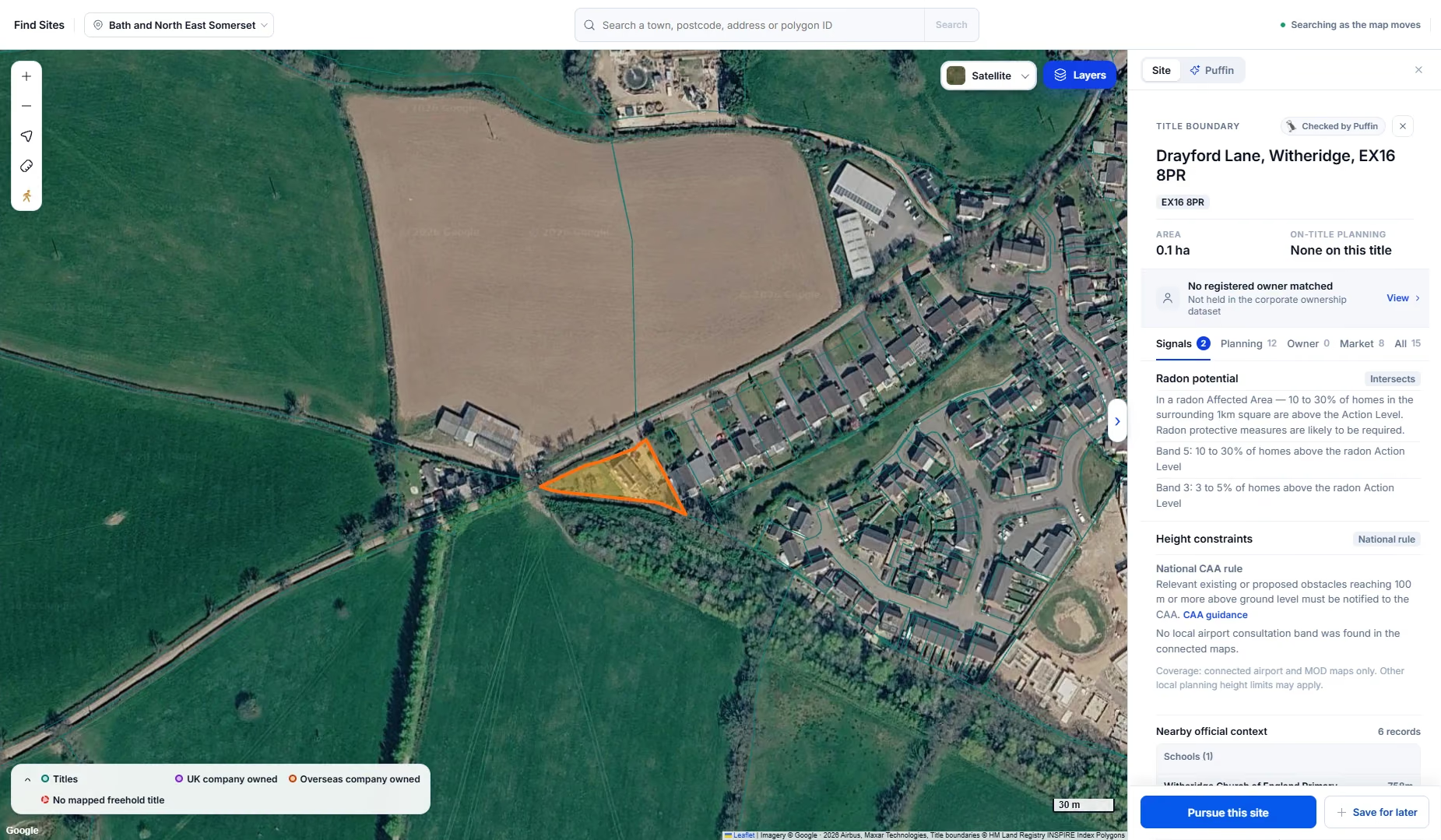
The example below is a 0.1 ha title on Drayford Lane in Witheridge, on the edge of a housing estate, with 12 planning records on and around it. No company is matched to this title, so the owner needs checking on the title register, which costs £7 and gives their name and address.
2. What to put in the letter
Start with who you are: your name, your company and what you build. A line or two is enough. Make it clear you're a real developer with a real interest in this site, not someone sending hundreds of identical letters.
Then name the land, in words the owner would use. For the Drayford Lane title, that might be "the land at the end of Drayford Lane, next to the houses". Add the title number so there is no doubt.
Say why you are interested, briefly. That the site could take a few homes is plenty for a first letter.
Finish with how to reach you, by phone and email, and make clear that a conversation does not commit them to anything.
The first letter
Copy this and change the highlighted parts. It should fit on one page.
[Your name]
[Company name]
[Your address]
[Phone] · [Email]
[Date]
[Owner's name, as on the title register]
[Address for service]
Dear [Mr / Mrs / Ms surname, or the company name],
Land at [site address] (title [title number])
My name is [your name] and I run [company name], a [small housebuilder / developer] based in [town]. We build [a short line on what you build, for example small schemes of two to eight homes].
I'm writing because I understand from HM Land Registry records that you own [a plain description of the land]. I think the site could be suitable for [a small number of new homes / your idea], and I would be interested in talking to you about it.
You may not be thinking of selling, but if it's something you'd be open to discussing, I'd be happy to have a quick chat with no obligation. Depending on your circumstances, we could talk about an outright purchase or an agreement subject to planning.
You can reach me on [phone] or at [email]. If you'd rather not hear from me again, just let me know and I won't write again.
Yours sincerely,
[Signature]
[Your name]
Keep the line about not writing again. Owners who are not interested will often say so, and that saves you sending a second letter that was never going to get a reply.
3. Mistakes that get letters ignored
A letter that starts "Dear Sir or Madam" or is addressed to "The Occupier" looks like a mailshot, and usually goes in the bin like one. If you have the owner's name from the register, use it.
Leave the price out. Any figure you give before you have spoken is likely to be wrong, and a low one can end the conversation before it starts.
Leave out plans, unit numbers and planning arguments too. They are for a meeting, once the owner has shown some interest.
Avoid anything that sounds like pressure, such as deadlines or "act now". Owners often take weeks to reply.
Check the address. The address for service is not always where the owner lives now. It can be an old home or a solicitor's office. If the owner may live at the property, send a copy there as well.
4. Following up
Many owners don't reply to a first letter, including some who are interested. They put it aside, or aren't sure it's genuine. If you haven't heard back after three or four weeks, it's reasonable to send one short follow-up.
Dear [name],
Land at [site address]
I wrote to you on [date of first letter] about the land at [site address]. I know letters like mine can arrive out of the blue, so I wanted to follow up in case it went astray.
I'm still interested in talking to you about the site, with no obligation. If now isn't the right time, that's fine. You're welcome to keep my details for later.
You can reach me on [phone] or at [email].
Yours sincerely,
[Your name]
If there's still no reply after two letters, stop and set a reminder for six to twelve months' time. Circumstances change, and an owner who wasn't interested this year might be next year.
5. Keep a record of every letter
Once you are writing to more than a handful of owners, it is easy to lose track of who has had what. For each site, record the date of each letter and the address you used, any reply and what was said, and when the next step is due. Keep a note of anyone who has asked not to be contacted again, and make sure they are not.
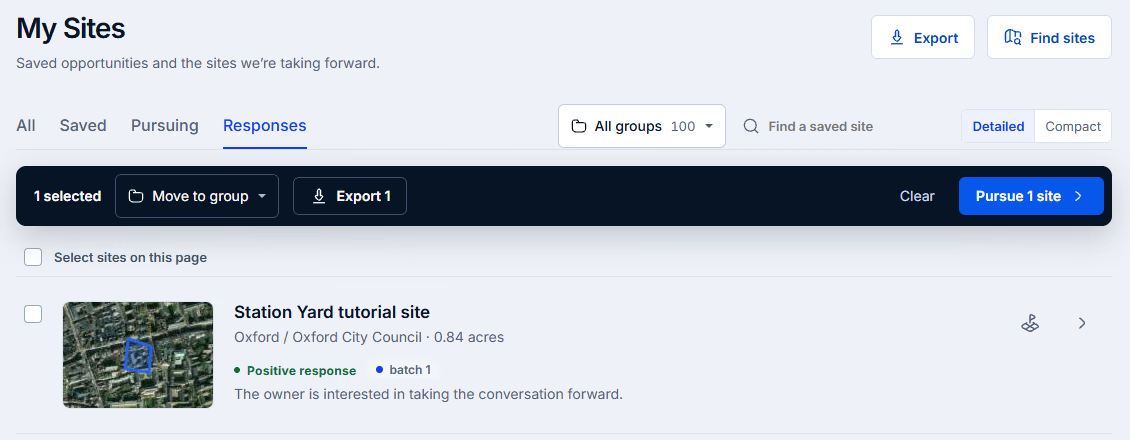
Send letters from Landicia
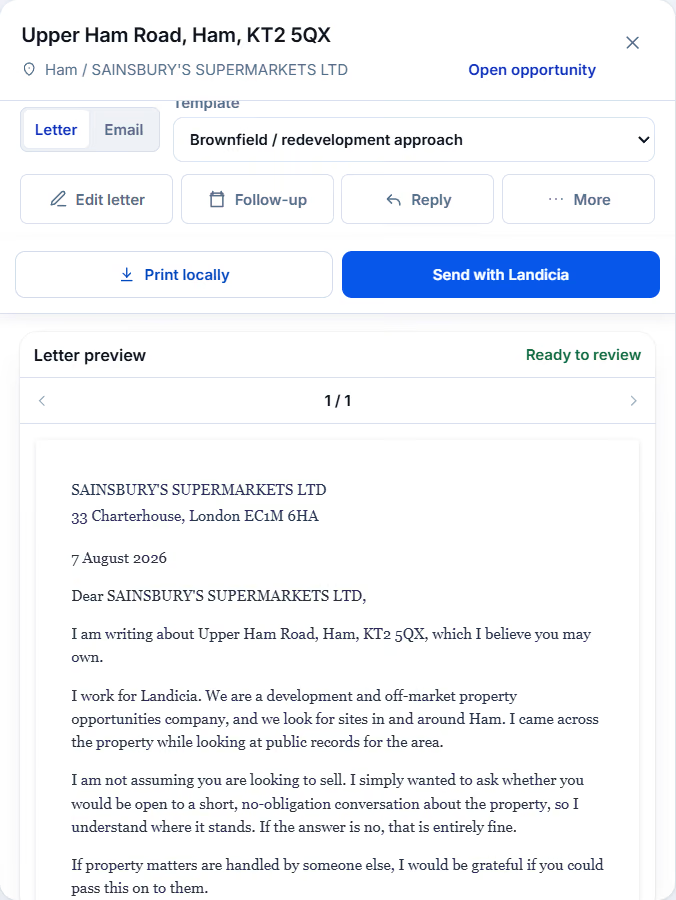
In Landicia, letters are drafted from the site record. The owner's name, address for service and the site details are already filled in.
Choose a template, edit the wording, then print the letter yourself or post it from the app. Ten posted letters a month are included in the subscription.
Follow-ups and replies are logged against the site, in the same place as its title and planning history.
If you would rather we found the sites and owners for you, Landicia Assisted searches against your brief. For the step before the letter, see our guides to finding out who owns land and SHLAA vs brownfield register.
Checked on 2 November 2026. This template is a starting point, not legal advice. Take advice before agreeing terms with a landowner.
See it on your own area
We load your target area before the call.